The momentum behind electric vehicles continues to accelerate, and the shift brings new complexities in packaging, efficiency, and system integration. In our recent blog on the evolution of New Mobility, we highlighted how electrification, thermal management, lightweighting, and high voltage architectures are reshaping the automotive landscape. One of the most significant engineering responses to these pressures is the rise of the e-axle. This compact drive unit combines the electric motor, power electronics, and transmission in a single housing.
The e-axle is more than a packaging solution. It is fast becoming the foundation of the next generation of electric powertrains, enabling higher efficiency, reduced mass, and more straightforward vehicle assembly. As Tier suppliers like Schaeffler and GKN continue to advance fully integrated drive modules, material performance is playing a crucial role in achieving higher voltages, tighter thermal control, and long-term reliability.
This article explores why the e-axle is central to future EV design and how AGC’s advanced materials can help manufacturers meet its demanding requirements.
The e-axle: the next step in electric powertrain evolution
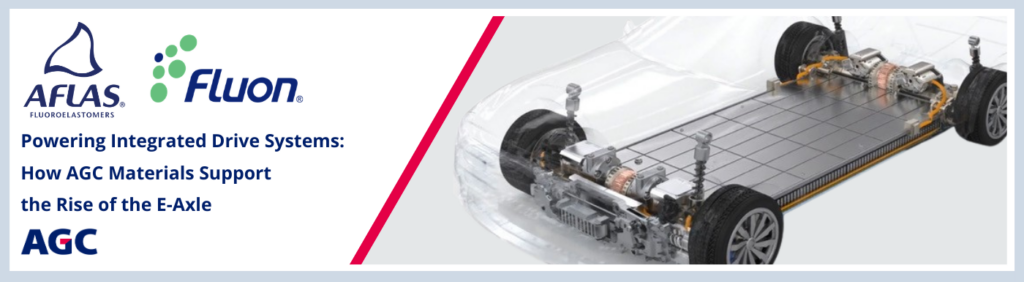
An e-axle brings the electric motor, inverter, and gearbox into one compact module. This integrated architecture helps OEMs reduce the number of separate components, optimise space, and deliver higher power density.
Recent developments show that integration is advancing rapidly:
- GKN’s high-efficiency e-axle for the electric London taxi brought motor, gearbox, and differential into a lightweight 17 kg module designed for urban mobility. (2018. GKN eAxle technology to the most advanced electric London taxi. https://www.electricmotornews.com/gb/veicoli-ecologici/gkn-taxi-londinesi-london-ev-company.
- Schaeffler’s latest “4-in-1” e-axle goes a step further by integrating the thermal management system directly into the housing, enabling more stable temperatures and improved system efficiency. (2022). Schaeffler to produce 4-in-1 electric drives incorporating thermal management systems. https://www.automotivepowertraintechnologyinternational.com/news/electric-powertrain-technologies/schaeffler-to-produce-4-in-1-electric-drives-incorporating-thermal-management-systems.html)
These examples reinforce the same industry patterns we highlighted previously: higher voltage systems, increased thermal loads, and greater expectations for durability and safety.
Why integration increases material demands
Bringing multiple high-performance components into a single assembly delivers efficiency benefits, but it also creates new stresses for the materials inside the system.
Higher thermal loads in smaller spaces
As design efficiencies within the industry bring/force motors and inverters closer together, heat builds faster and dissipates more slowly. Thermal stability and reliable cooling paths are essential to prevent performance loss or long-term degradation. AGC materials used in magnet wire insulation must perform within demanding temperature classes defined in LV112, including Class D 150°C, Class E 175°C, Class E extended to 180°C, and Class F 200°C. These temperatures reflect the real thermal environment inside densely packaged e-axle housings.
More complex sealing environments
E-axles manage lubricants, coolants, electromagnetic components, and mechanical loads in a single housing. This requires seals and gaskets that resist aggressive fluids, pressure cycles, and temperature fluctuations.
AFLAS® performs particularly well in these applications due to its fluorinated backbone, which provides superior chemical resistance and very low permeation in coolants and glycols. In glycols, AFLAS® shows permeation rates of 0.2 to 0.4 cc·mm/m²·day·atm compared to 3 to 5 for Viton and 4 to 6 for NBR. This makes AFLAS® one of the most reliable elastomers for sealing e-axle environments exposed to mixed coolants.
High voltage insulation under mechanical stress
E-axles must carry high-voltage wiring within or close to the drive unit. Insulation materials need to deliver dielectric strength, flexibility, and resistance to abrasion and vibration.
AGC plays an active role in supporting resolver units and magnet wire insulation. These components require stable, high dielectric materials to ensure accurate position sensing and reliable inverter-to-motor communication under vibration and thermal cycling.
Lightweighting without sacrificing strength
Integrating components reduces overall mass but also demands thinner walls, smaller envelopes, and more durable insulation and coatings that maintain reliability under these constraints.
These engineering challenges align directly with the areas where AGC’s fluoropolymers and elastomers provide clear advantages.
High-voltage insulation for 800 V+ e-axles
As e-axles move toward 800 V and higher system voltages, cable insulation becomes a critical enabler of compact and efficient drive units. AGC’s Fluon® ETFE-based high-voltage insulation materials offer the dielectric strength, thermal stability, and mechanical durability required for these advanced architectures. Their ability to deliver high performance at thinner wall thicknesses supports tighter packaging inside the e-axle housing, reduced weight, and improved routing flexibility. This combination of electrical reliability and design freedom positions AGC as a reference supplier for high-voltage cabling used in next-generation e-axle platforms.
PTFE exhibits the best overall barrier properties for coolant-rich e-axle environments, followed closely by PFA and ETFE. All three significantly outperform commodity materials such as HDPE and PP, especially in permeation and long-term chemical resistance. This ensures stability even where high-voltage cables run close to coolant channels or lubrication circuits.
Fluon® ETFE. Transitioning from ICE to electric powertrains
ETFE has long been valued across automotive platforms, but the shift from internal combustion to e-mobility has unlocked new opportunities for this high-performance material. The thermal loads, voltage demands, and chemical environments within modern e-axles are more severe than anything encountered in ICE-era wiring systems. ETFE’s dielectric strength, abrasion resistance, and compatibility with aggressive coolants make it exceptionally well suited to the conditions inside integrated electric drive units. This transition is enabling AGC to reposition its ETFE portfolio as OEMs redesign cable systems for the next generation of electric powertrains.
AGC’s AH series grades mirror ETFE’s performance closely, with only minor chemical differences of around one percent. Even with fillers, these materials significantly outperform commodity polymers and elastomers, especially in refrigerant systems where ETFE offers substantially lower permeation than AFLAS®, EPDM, or NBR.
How AGC materials support e-axle performance
AGC Chemicals has long supported the mobility sector with high-performance materials for electrification, insulation, and thermal management. Many of these same technologies are ideally suited to the demands of integrated e-axle systems.
High-voltage insulation for motor windings and cables
As e-axles increasingly adopt 800V architectures, insulation reliability is crucial. Fluon+ filled PTFE compounds and AGC’s fluoropolymer-based cable materials provide:
- High dielectric strength.
- Thermal stability for fast-charging environments.
- Flexibility for tight packaging.
- Abrasion resistance for high-vibration assemblies.
AGC’s materials are engineered to meet the insulation demands of resolver and magnet wire systems, supporting accurate motor control and long-term reliability in compact e-axle designs.
Seals and gaskets for mixed thermal and chemical environments
AGC’s AFLAS® fluoroelastomers deliver outstanding resistance to heat, lubricants, coolant mixtures, and pressure cycles. This makes them suitable for sealing applications within:
- Power electronics housings.
- Coolant interfaces.
- Multi-fluid environments created by integrated thermal systems.
As integration increases, so does the importance of seals that maintain integrity across varied conditions.
Compared with EPDM and NBR, AFLAS® offers dramatically lower permeation in oils, coolants, and refrigerants. For example, in R-134a refrigerant, AFLAS® shows permeation around 0.8 to 1.2 cc·mm/m²·day·atm compared to 10 to 15 for EPDM and 3 to 5 for NBR. This makes AFLAS® particularly valuable in e-axle systems where coolant circuits and refrigerant-based thermal systems sit close to electronic components.
Materials for coolant channels and thermal systems
With suppliers like Schaeffler now incorporating full thermal management into the drive unit itself, materials that resist permeation and aggressive coolants become essential. AGC’s portfolio offers solutions for coolant lines and components that require stability at both low and high temperatures.
ETFE, PTFE, and PFA all provide exceptional barrier performance in refrigerant systems used in advanced thermal-management loops, a growing trend in high-efficiency e-axle designs. This makes them strong candidates for next-generation coolant and refrigerant routing within the drive housing.
Lightweight films, coatings, and structural materials
AGC’s advanced coatings and fluoropolymer films provide lightweight alternatives to traditional metals for housings, insulation barriers, and protective layers. These materials help:
- Reduce mass.
- Improve corrosion resistance.
- Support compact, high-density layouts.
- Enhance long-term reliability in harsh conditions.
These developments align with the broader lightweighting trends described in the previous AGC mobility blog.
Scaling e-axles from passenger cars to commercial and heavy vehicles
While early e-axle technologies focused on compact passenger vehicles, manufacturers are now applying the concept to larger platforms.
Thermal loads, torque requirements, and structural stresses increase dramatically in commercial, off-highway, and heavy-duty applications.
Material challenges intensify across:
- Higher torque transmissions.
- Larger integrated housings.
- Greater vibration and shock loads.
- Higher continuous operating temperatures.
AGC’s global materials offering, which includes high-temperature fluoropolymers and durable elastomers, is well aligned with these emerging requirements.
Supporting long-term EV platforms through supply chain reliability
As OEMs bring new EV platforms to market, long-term supply security has become as important as technical performance. AGC’s global manufacturing footprint, consistent quality standards, and proven fluoropolymer production capability give customers confidence in multi-year EV programme commitments. The ability to deliver stable volumes of ETFE and high-voltage insulation materials at scale helps OEMs and Tier suppliers reduce risk, streamline sourcing, and secure dependable supply for future e-axle programmes. This supply chain strength is a key element in AGC’s role as a long-term partner for electrified drivetrains.
The future: more integration, higher voltages, smarter materials
The e-axle will continue to evolve, shaped by both performance and sustainability targets. Emerging trends include:
- Wider adoption of 800 V and 1000 V systems for faster charging and smaller conductors.
- Integration of heat pumps and energy recuperation systems.
- Increased use of composite or hybrid housings to reduce weight.
- Smarter materials with embedded sensing or enhanced diagnostics.
- Greater focus on recyclability and lifecycle value.
Each of these trends increases the importance of materials that combine performance, reliability, and design flexibility.
AGC’s role in the next generation of electric drive units
E-axles represent a major step in the evolution of electric drive systems. Their success depends on materials that can withstand higher voltages, tighter packaging, greater thermal loads, and more complex operating conditions. By combining advanced ETFE-based insulation with a secure global supply network, AGC is helping shape the next generation of electrified drivetrains. As the industry moves toward higher power densities and fully integrated systems, AGC’s materials and supply reliability will play an essential role in driving performance, safety, and long-term manufacturing confidence.