As the world prepares for the 2026 FIFA World Cup, attention is already turning to the venues that will host the tournament’s biggest matches. The competition officially begins on 11 June 2026, with SoFi Stadium in Los Angeles hosting its first World Cup fixture on 12 June as one of the centrepiece venues in the United States.
Already recognised as one of the most advanced sporting venues ever constructed, SoFi Stadium represents a significant achievement in structural engineering, materials technology, and environmental design. While the stadium is widely known for its scale and spectator experience, one of its most technically ambitious features sits above the field: its vast ETFE roof structure, manufactured using AGC’s Fluon® ETFE fluoropolymer materials.
Engineering a Different Kind of Stadium
Designed by global architecture firm HKS in collaboration with structural and engineering specialists, SoFi Stadium was conceived as an indoor-outdoor venue capable of delivering environmental protection, daylight management, and spectator comfort at an unprecedented scale. Achieving this required a lightweight roofing solution capable of spanning vast areas while maintaining transparency, thermal performance, and long-term durability, making ETFE a natural choice for the project.
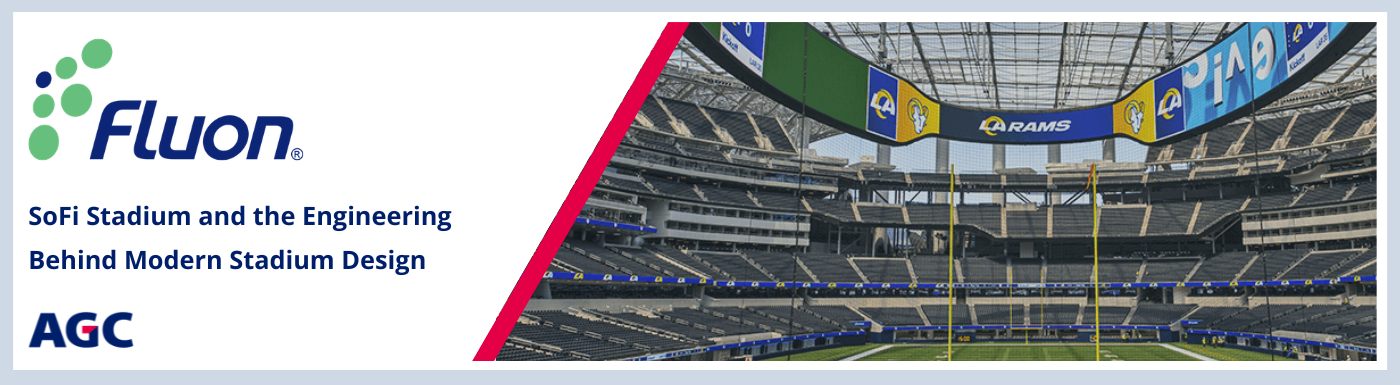
Opened in 2020 in Inglewood, California, the stadium features a sweeping cable-net roof structure spanning approximately one million square feet across the main bowl, the adjacent performance venue, and surrounding public spaces. Rather than relying on conventional glazing systems, the project utilised ETFE panels fabricated using AGC’s Fluon® ETFE material.
The lightweight nature of ETFE was central to the roof design’s feasibility. Compared with glass, ETFE significantly reduces dead load, enabling longer unsupported spans while reducing the amount of structural steel required. On a project of this scale, weight reduction directly influences structural efficiency, fabrication complexity, and overall construction strategy.
The roof itself consists of a series of ETFE panels tensioned within a sophisticated cable-supported structural system, creating a translucent enclosure that protects spectators while maintaining the open-air atmosphere intended by the design team.
Why ETFE Was Selected
ETFE has become increasingly important in large-span architectural applications because it combines mechanical performance with optical and environmental advantages.
For SoFi Stadium, several material characteristics were particularly important:
- High light transmission, allowing natural daylight penetration across the stadium bowl.
- Excellent UV and weather resistance for long-term outdoor performance.
- Low surface energy, supporting self-cleaning behaviour and reduced maintenance.
- High toughness and puncture resistance despite low film thickness.
- Significantly lower weight compared with conventional glazing materials.
- Design flexibility for complex geometries and cable-supported structures.
The Fluon® ETFE grades used for the project were processed into films of varying thicknesses and incorporated customised frit patterns to assist with solar management and glare reduction. This was especially important given the climatic conditions in Southern California, where solar loading and internal thermal comfort were key engineering considerations.
Unlike opaque roofing systems, the ETFE roof allows natural daylight to enter the venue while helping create a more balanced internal lighting environment, reducing dependence on artificial lighting during daytime operation.
Structural and Environmental Performance
One of the major engineering challenges associated with modern stadium roofs is balancing transparency with environmental performance.
The SoFi roof system addresses this through a combination of material selection, frit design, ventilation integration, and cable-supported structural engineering. Operable roof openings allow controlled airflow throughout the venue, supporting passive environmental management strategies and improving spectator comfort.
Fluoropolymer materials such as Fluon® ETFE also provide excellent resistance to UV degradation and long-term weathering, making them highly suitable for demanding architectural applications.
From a sustainability perspective, ETFE systems can reduce structural mass and lower material consumption compared with heavier conventional alternatives. The long service life and low maintenance requirements of ETFE also support whole-life performance objectives increasingly demanded in modern infrastructure projects.
A Material Associated with Landmark Venues
SoFi Stadium joins a growing list of globally recognised projects that have utilised ETFE technology to achieve ambitious architectural and engineering goals.
From Allianz Arena in Munich to Forsyth Barr Stadium in New Zealand and the Beijing National Aquatics Centre, ETFE continues to enable lightweight, highly transparent building envelopes across sports and entertainment infrastructure.
What makes SoFi Stadium particularly notable is the scale of the application and the integration of multiple engineering disciplines within a single roof system. Structural engineering, environmental control, materials science, and digital display technologies all intersect within one of the most technically advanced stadium developments completed in recent years.
As the world’s attention turns to Los Angeles during the 2026 FIFA World Cup, SoFi Stadium once again demonstrates how advanced materials such as AGC’s Fluon® ETFE continue to expand what is possible in modern architectural engineering.